Interview
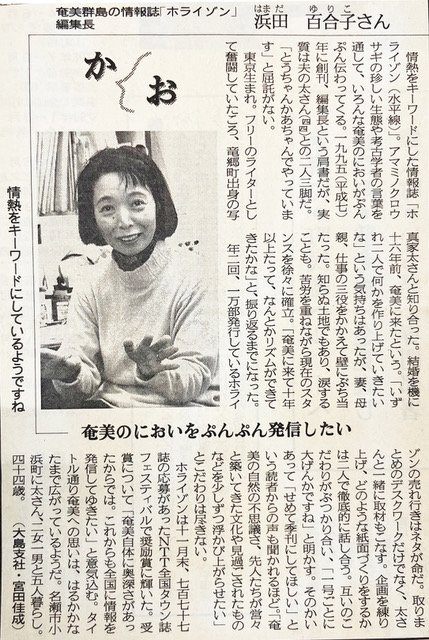
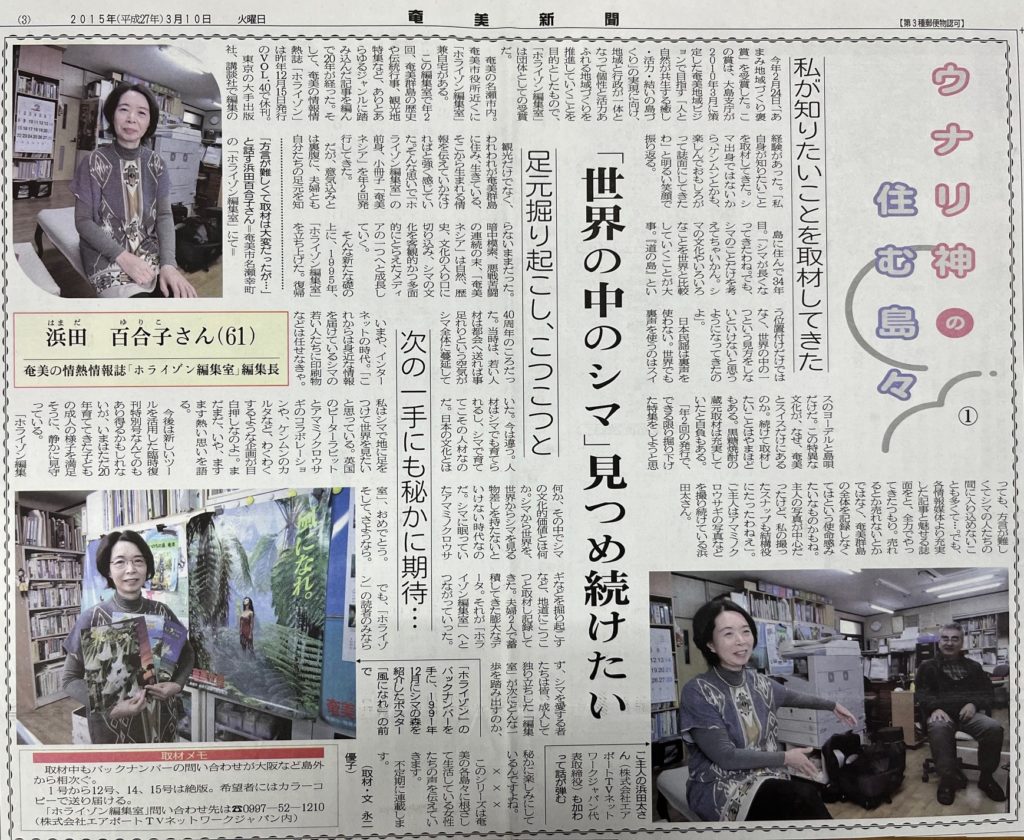
Yuriko Hamada
Interview with Kuwahara Sueo
Interview questions and transcript curation: Papoutsaki Evangelia
This interview with Yuriko Hamada chronicles the remarkable journey of a Tokyo-born woman who became the heart and soul of a defining publication for the Amami Islands. It is a story of serendipity, passion, and a deep, cultivated love for a land she initially knew nothing about.
Yuriko’s life on Amami Oshima began over four decades ago, following her marriage to Hamada, a local photographer. Leaving behind the monochrome feel of the city, she was immediately struck by the stunning emerald-blue sea and the vibrant, almost metropolitan atmosphere of Naze city. Despite initial family concerns about island life, Yuriko arrived with an open mind, free from preconceptions.
The genesis of the archipelago magazine “Horizon” (ホライゾン) was rooted in her and her husband’s collaborative work on school albums and municipal publications. A pivotal opportunity arose in 1988 with a request to produce an event bulletin, which evolved into their ambitious project. The name “Horizon” was chosen for its connection to the sea that unites all the islands, symbolizing the boundless potential and mythical promise of Amami.
Driven by the powerful metaphor of Amami as a “sleeping lion”—a place of immense but undiscovered wonder—Yuriko dedicated herself to awakening it through the pages of “Horizon.” The magazine’s distinctive concept was to move beyond superficial tourism information and delve into the essence of the islands: its profound history, rich culture, unique nature, and the lives of its people. She championed a “bite-sized” editorial approach, making the complexities of Amami accessible and engaging for outsiders and locals alike.
For twenty years, Yuriko single-handedly shouldered the roles of editor, researcher, and writer, fueled by a profound sense of responsibility rather than financial gain. “Horizon” became a platform for local voices and experts, celebrating everything from the enigmatic Amami rabbit and the forest spirit Kemmun to the poignant depth of island songs (shima-uta) and the wisdom of local cuisine.
The magazine’s national recognition, winning awards in competitions against hundreds of other regional publications, stands as a testament to its quality and significance. While “Horizon” concluded its print run after two decades, its mission continues through a bilingual (Japanese/English) online platform, ensuring that the stories of Amami’s interconnected nature and culture can now reach a global audience, especially following the islands’ designation as a UNESCO World Natural Heritage site.
This interview reveals Yuriko Hamada not just as an editor, but as a cultural bridge—an outsider who, through relentless curiosity and passion, became one of Amami’s most dedicated storytellers, forever capturing the spirit of the islands she chose to call home.
How did you come to live on Amami Oshima?
I had a friend from university who worked at Kodansha. At the time, I had also quit my job at a legal publishing company and was working freelance with her. She invited me to dinner once. It was an era without mobile phones like today, so I went to a meeting spot nearby at 6 p.m. She was delayed due to work, and Hamada came as the contact person. He was working in the photography department at Kodansha then, and that’s where we first met. With his strong facial features, I thought he might be from Hokkaido (Ainu) or Okinawa. I assumed he was married, but when we talked, he had an unpretentious personality, and we got along quite well. I suppose I didn’t really like big cities much. Looking back now, maybe the monochrome feel of city skyscrapers didn’t suit me. Or perhaps because I was slightly anemic, my head always felt heavy. I hadn’t thought at all about going to an island then, but shortly after we met, we started talking about marriage. At the time, he said he was from Oshima, not Amami specifically. Being born in Tokyo, I assumed he meant Izu Oshima. Even when I asked what kind of place it was, he would only say, “You’ll understand when you come see it,” and wouldn’t give me specifics, so I decided to go anyway.
What was your first impression?
My first trip to Amami Oshima was about 45 years ago, around 1980. When I first went to Amami Oshima, I thought for an island, it had a lot of buildings. It gave me an impression similar to Tokyo’s old downtown areas. When people think of Amami Oshima, they might imagine many habu snakes and a rustic feel, but the main street in Naze was perhaps like Ginza in Tokyo. It seemed to be the era when Oshima Tsumugi silk was selling well, and all the women were very fashionable. I was often told, “You don’t dress like someone from Tokyo,” because I was mostly without makeup, wearing jeans and a T-shirt.
It was urban with many buildings, and the color of the sea was surprisingly beautiful. The first place he took me to was Ohama Beach. Until then, the only sea I knew was like the one in Chiba I visited during a school seaside camp. Thinking back, it was murky, but I thought that was what the sea was like. At the time, a novel by Ryu Murakami, “Almost Transparent Blue,” was popular, but I didn’t understand what the color “almost transparent blue” meant. When I saw the sea at Ohama, I finally understood—it was that clear blue color right before my eyes, and I was deeply moved. I also found the blue-painted roofs of the town’s houses charmingly simple and storybook-like.
Have you lived in Naze since the beginning?
Hamada’s hometown is the En community in Tatsugo Town, and we visited En to greet his family and relatives who live there. However, since his workplace was in Naze City, we started living in Naze. I visited once before marriage, and we had our wedding ceremony in Amami a year later. I was surprised by the 300 guests.
Did your parents say anything?
My mother seemed resistant to the idea of me moving to an island. I think she had heard about someone in the neighborhood who married into a family in Shikoku and had a very hard time. So, regarding the island, she was more worried than opposed. She provided us with various kinds of support for life on the island.
My father did not object. Perhaps it was because Hamada seemed genuine; when Hamada came to greet them, my father smiled and said, “Congratulations.” For the wedding, it seems he brought about ten relatives and then went on a sightseeing trip to Okinawa. He was so moved upon arriving in Amami that he wrote a tanka poem about it, which we still keep displayed at our family Buddhist altar.
Did you have any reservations at all about living on an island?
I truly had no knowledge about the island. I didn’t know where Amami was located or that Oshima Tsumugi was famous. When I thought of islands, I remembered the TV show “Hyokkori Hyoutanjima,” which I loved as a child, and songs like “Shima Sodachi” and “Shima no Blues,” which were popular and we often sang in elementary school. I had a classmate from Okinawa who performed a Ryukyu dance at our graduation thank-you party, and I thought it was wonderful. So, I didn’t have the kind of discriminatory thoughts my mother worried about, and I had no reservations. However, when I tried to find it on a map, it took a while, and when I finally found it, it was really just a tiny speck, so I did feel some anxiety then.
How was life on the island back then?
In reality, it was quite tough. Coming from a family of civil servants, I had no experience in business and had never said “Welcome” to customers. Also, both of Hamada’s older brothers were in photography-related work. The idea was that the three of them would work hard together, but things didn’t go as smoothly as hoped. Thinking that having brothers in the same trade in the small town of Naze would mean competing for the same customers, we decided not to open a camera sales or DPE shop but instead started a photo studio. Also, since I had previous experience in editing, I helped Hamada with shoots like weddings and 100-day baby photos, and we gradually got work creating school albums for several schools. However, school albums had low profit margins, so while looking for other work, we coincidentally got an opportunity from the Planning Section of Setouchi Town Office to produce the town’s overview brochure. This led to us getting printing-related work for departments like the Tourism Section and Social Education Section.
Back then, it seemed that both Naze and other remote island municipalities placed orders with companies in Kagoshima. Hamada negotiated persistently during sales visits, asking them to let local businesses handle what they could to foster local growth. After that, we were able to get work from several municipalities like Naze City, Tatsugo Town, Kasaricho, and Kikaijima. It seemed there were opportunities to reassess things in various situations, and we utilized those photographs…
You were for many years the editor of the Horizon, the Amami islands archipelago magazine, the only available publication on the islands about the islands and from the islands. When and how did you come to start the magazine?
Besides school albums and municipal overviews, we gradually started handling work related to Amami’s representative specialties like kokuto shochu, Oshima Tsumugi silk, and agricultural products, as well as tourism posters and pamphlets. Although Hamada had once yearned for the city, after returning to his hometown, he began capturing not just the beauty of the scenery but also the appeal and interesting aspects of the island in his photographs.
In 1988, we received a request from the Amami Islands Tourism Federation, which was part of the Kagoshima Prefecture Oshima Branch Office’s Commerce, Fisheries, and Tourism Section, to produce an event information paper for the Amami Islands. This was our first job from Kagoshima Prefecture. It was a simple introduction, with photos and text, of schedules and locations for local performing arts and sports events across the Amami Islands. Perhaps playing on the term “Yaponesia” proposed by Toshio Shimaoo, we started production under the title “Amaminesia.” This was the predecessor to “Horizon.” It was an A4-size, 12-page publication. While producing this, we proposed including feature articles in addition to just event information.
Apart from including event information for the archipelago, most of the content was based on our proposals. For example, regarding culture, when the NHK historical drama “Tobuga Gotoku,” featuring Takamori Saigo, was broadcast, we introduced related anecdotes and historical sites in Amami, Tokunoshima, and Okinoerabujima. We featured things like the “Amami Ten Views,” characteristics of coral reefs seen around the islands, and major fishing spots, introducing culture and nature in simple two-page spreads. We sometimes included a bit about industry on the back. We got the job because our photos were beautiful, and we aimed to create a booklet that met expectations while making good use of photography. However, even with feature pages, the rest was event information, and I developed a desire to create a magazine that could delve deeper into Amami’s essence. When we proposed this to the prefectural officials, they were very enthusiastic, and the meeting proceeded very animatedly.
There were budget constraints, but we had the desire to create something good, something unprecedented. We decided on 24 pages total and, within the twice-yearly publication schedule, tried to think of themes encompassing the entire archipelago as requested by the Tourism Federation. We searched through various materials. It was an era when there were no guidebooks for Amami. There were some tourist pamphlets, but they contained only superficial information. While sea views were featured, introductions of the forest were almost nonexistent; even the introduction of the Amami rabbit might only show a photo of a stuffed specimen. In 1991, the posters “Be the Wind” and “Be the Light,” which we created for the Naze City Tourism Section, were very well-received. I believe this was the first time the forests of Amami came into the spotlight. This perspective on the forest was groundbreaking. Until then, even though forests existed, they were almost treated as if they weren’t.
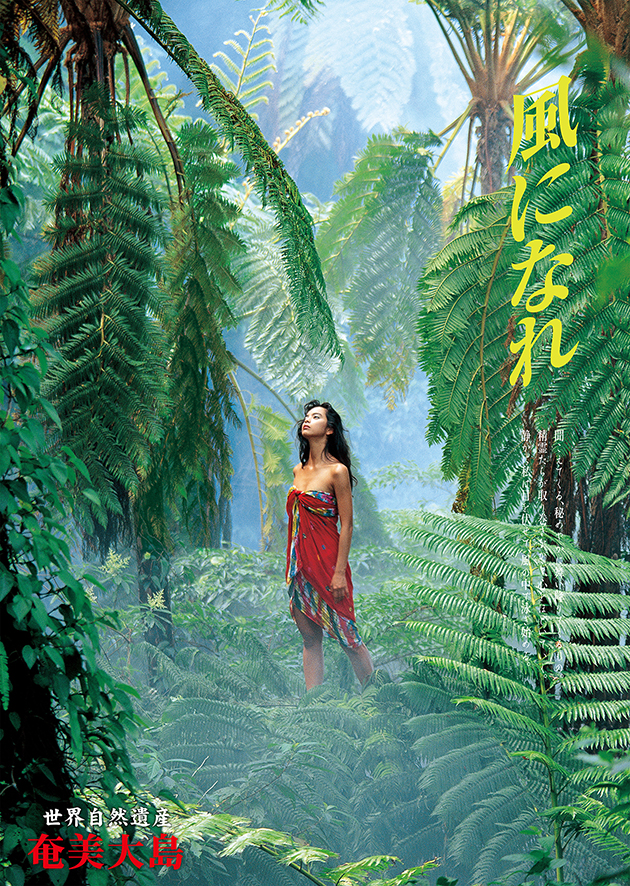
"Be the Wind" poster (1991)
Even for introducing Amami, if I, as someone not from Amami, didn’t study, I couldn’t convey anything to the readers. To learn about Amami, I desperately went to libraries and used bookstores looking for books related to Amami, but the information I wanted was scarce, and many were academic research books. So, I started collecting newspaper clippings, pamphlets from each municipality, pamphlets from souvenir shops, promotional phrases, even things written on chopstick wrappers when eating out—even the smallest things were fresh information to me. I sorted them into paper bags by category and studied them thoroughly.
During this process, I encountered “Coralway,” the inflight magazine of what is now Japan Transocean Air. When I went to Okinawa, I found it so wonderful that I brought a copy back. Its page design, filled with beautiful photos and illustrations covering Okinawa’s nature, culture, history, local products, and people’s lives, was full of clever ideas making it enjoyable to read. I used this booklet as a textbook for our new magazine (later “Horizon”). I also learned about design, composition, and themes from various other magazines. Among them, I referred to Shogakukan’s “Sara” magazine for interview techniques, which helped with series like “Dream Chasers.”
Since we couldn’t afford to hire anyone, we decided between ourselves: Hamada would handle photography and sales, and I would handle interviews and editing. I was anxious and lacked confidence that we could sustain it, but we found joy in producing things related to Amami together. When we decided to marry, one of our dreams was to create something in Amami.
What was the original concept? What made it distinctive?
We wanted to include not just visible information like event details, scenery, and buildings, but also the invisible elements essential for talking about the island—history, culture, folktales, language, music, and the people living on the island. What we focused on was creating a visually appealing booklet with beautiful photos so people would pick it up, making it enjoyable and easy to understand Amami’s essence in bite-sized portions. We wanted to introduce Amami’s history, nature, culture, and its people. And we made an effort to ensure it was a transmission from the people of Amami, from Amami itself—even though I’m not originally from there (laughs).
We shared the desire to publish a magazine from the island that would have impactful photos on the cover to make people pick it up, and where each opened page would convey the interest of Amami in bite-sized pieces. My insistence on bite-sized information came from my constant thought that it would be good if outsiders like me could learn about Amami compactly and understand its essence. I myself, having arrived in a completely unknown place, wanted such an information magazine.
Things that are ordinary for islanders can be very novel from an outside perspective. When I first came to Amami, everything was fascinating, and I wanted to learn more about its history, legends, and scientific background, so I often asked Hamada. Even understanding everyday things, specialized knowledge was hard to come by, so my mind was always full of question marks: why? how? I had so many things I wanted to know: local cuisine, island songs, the forest and rare creatures, the beautiful sea and colorful fish, coral reefs, dialects, local performing arts, etc. I also felt a sense of responsibility as a parent to convey these to my own children. I wanted to know about Amami, including its negative aspects like the dialect abolition movement and island discrimination.
The idea to delve into various themes of Amami in “Horizon” was greatly influenced by encountering the phrase, “Amami is a sleeping lion.” I came across this essay while searching through various materials. It’s buried in a mountain of documents and I can’t find it now, but I think it was by a university professor from Amami. Encountering these words, I wanted to try and wake this sleeping lion that is Amami.
In my own interpretation, I thought it meant that Amami is actually a significant presence like a lion, but its interesting and wonderful aspects remain largely unknown, as if sleeping. And I thought, I must find a way to shake this sleeping lion awake. It felt as if the phrase was telling me that once awakened, it would reveal its true, significant presence as a lion. In the past, there was a kind of “scorched picture” where you drew pictures or words on Japanese paper with mandarin orange juice and heated it over a brazier, making the image appear. Similarly, I imagined that by delving into various themes of Amami, the lion that is Amami would be revealed. I thought perhaps “Horizon’s” role was to delve into each theme and make the lion emerge. I was greatly influenced by those words.
The Amami Islands Tourism Federation at the time only requested that we cover the archipelago equally. And, to help cover expenses, we asked permission to include private commercials. Thanks to the section chief’s decisive judgment, this was approved. This was very innovative for the time, and I remain deeply grateful. Later, it evolved with sponsorship from the (General Incorporated Association) Amami Islands Tourism and Products Association and the Amami Islands Wide-Area Administrative Association. However, with cooperation funds from each municipality and advertising fees from private companies, “Horizon” was able to launch as a community revitalization booklet.
The advertisements provided some financial support, which we appreciated. We asked for cooperation, explaining it was a magazine for island revitalization. However, because we wanted to create a quality product, printing costs were high. Even ignoring our own photography and editing fees, it was a stretch just to cover printing and miscellaneous expenses. We were particularly particular about color reproduction in the photos, which increased printing and design costs. But the truth is, we managed out of a sense of responsibility and a desire to try it ourselves. Being able to research things I was curious about as a paid job was something I was very grateful for.
How did you come up with the title of your magazine “Horizon”?
The Amami Islands Tourism Federation said the booklet’s title should be something common to all the Amami islands. Various suggestions were made in the meeting, but the common point was, of course, the “sea.” From there, the word “horizontal line” (suiheisen) was suggested, and then the idea came up to use the English word “Horizon.” Everyone agreed, and the title was decided. In Amami, it has been believed that beyond the horizon lies the Land of Abundance (Neriya Kanaya). The horizon, visible equally from all the Amami Islands, also represents Neriya Kanaya. We all rejoiced, thinking it was a great title. However, upon learning there was an English textbook titled “Horizon,” I immediately contacted the publisher. I was concerned that if we were later served with an injunction, it would be terrible, but we received confirmation that “for a regional booklet, it’s not a problem.”
Furthermore, adding the word “passion” as in “Amami’s Passion Information Magazine” reflected our feelings. We infused it with the thought, “We may not have money, but we have passion.” Although I didn’t know Amami, while working on this booklet, I met and learned from various people all over the archipelago. We sometimes extended our reach to places like the Tokara Islands and Okinawan remote islands. Considering the expenses, it wasn’t cost-effective, but if I wanted to know something, I tended to take action. However, I thought comparing within the context of relationships with Kagoshima and Okinawa was necessary, and that Amami’s characteristics would stand out more strongly.
Did you have any particular favorite themes?
Hamada had apparently aspired to be a fashion photographer in Tokyo, but after returning to the island, he seemed to be rediscovering the appeal of local performing arts and such. Then, at some point, he encountered the Amami rabbit and seemed to have an epiphany about nature. While I was more moved by the beauty of the sea, Hamada became fascinated by the forest and subsequently made frequent trips there. At the time, ordinary islanders avoided entering the forest due to habu snakes and Kemnun (forest spirits), but forest plants, creatures, and Kemnun stories became major themes. We featured the nationally designated Special Natural Monument, the Amami rabbit, as well as the forest guardian Kemnun and habu snakes, including old tales, multiple times in the magazine. They are very interesting themes.
My interests were first food and island songs (shima uta). When I first heard shima uta, I didn’t understand the words or singing style at all; it was a strange, almost scary experience. There was a mini-concert by the singer Toshio Tsuboyama in Naze’s shopping street, but there was a unique atmosphere and words only islanders understood, so I couldn’t approach it. Later, I found a collection of shima uta lyrics written by Yoshimori Ehara at a used bookstore, and as I read it, I was moved to the point of getting goosebumps. I thought shima uta was Amami’s “Manyoshu” (classic poetry anthology). The open-hearted romance and straightforward love songs were very moving. I was also amazed that islanders back then, without a writing system, improvised these songs and passed them down for hundreds of years. The unique vocal techniques and falsetto were bewildering, but I wanted to somehow convey their depth through “Horizon.” My interest kept expanding to include the background, the culture of song games (utausobi), drums, sanshin, popular singers, and more.
I think food is a theme many people are interested in. Why a certain dish was created, cooking methods, recipes, nutritional aspects—various interests grow. When I first came to Amami, I was treated to Buta-gurise Yawaraka (pork with vegetables) in En, Tatsugo Town. The size of the pork was so large, I thought it might be as big as a baby’s head. The tsukabuki (butterbur) soaked in broth was healthy, and its deliciousness remains unchanged to this day.
Also, among Abura Somen (oil noodles), the deliciousness of Dashi Somen (broth noodles) was exceptional. I accompanied Hamada for a shoot in the Akina area during an event where people go around houses performing the August Dance. When the dance paused for a moment, someone said “kurukuru pon!” and tossed some into my mouth. The taste was astonishingly delicious, so much so I dreamed about it. After asking various people, I finally learned it was Dashi Somen, noodles fully soaked in broth. I still think this is delicious enough to rival any high-class cuisine. In Amami, they make broth with small fish. I think these hidden techniques enhance the flavor. Recently, I worked on a piece about Okinawan cuisine. I think Amami’s Abura Somen is influenced by Somin Tashiya, which has long been passed down in Okinawa, but in Okinawa, they make it without adding broth. Seeing such differences in various places allows one to glimpse the wisdom of Amami’s predecessors, who pursued originality while being influenced.
How many people were involved in running the magazine?
We launched “Horizon,” Amami’s Passion Information Magazine, in August 1995. The cover featured a beautiful, emerald-green glowing horizon photo, reflecting the origin of the title. The opening essay, titled “The Islands Where Godzilla is Visible,” was written by the director because Godzilla was filmed in Amami for a Toho movie. For the first feature, thinking we must first know about the island we live on since ancient times, we did an interview with Kiyomi Nakayama, an Amami archaeologist, titled “Ancient Amami Begins to Speak.” While archaeology can seem rigid, through Nakayama’s narrative, one could almost see the figures of ancient Amami people. I believe we managed to express a dynamism that allows one to imagine the ancient past in a way not possible with academic texts.

Horizon Vol.1
We also started a series called “Another Local History — Food.” The first installment featured “Chauke Miso” (miso relish). Chauke Miso, made with various ingredients, was commonly eaten in Amami, but its deliciousness was unknown in cities. As a simple, tasty food representing Amami’s cuisine, we introduced it in the first piece. The writer was Kazuko Izumi. I happened to read her essay and felt it conveyed the appeal of Amami’s food very well, so I asked her. She included memories of Chauke Miso along with a folktale and added a recipe. We also interviewed a miso-making expert and introduced how to make koji. We used these methods for other topics as well, changing the theme. It was about the wisdom, tastes, and stories from the past living in the present. Local cuisine has been passed down through people eating it over long periods. Some are original to Amami, while others show influences from Okinawa, Kagoshima, or even China. When and how they were transmitted, how they differ or are the same as in their places of origin, were all very interesting. The origins of uniquely Amami dishes like “Sangon” and “Keihan” are still fascinating to me.
Furthermore, under the title “Shooting the Island,” we were able to have a series by民俗写真家 (folkloric photographer) Hideo Haga, featuring his photos from 40 years ago in Amami along with a 500-word essay. Mr. Haga was part of an academic research team from the Nine Society Union and took documentary photographs of the Amami Islands immediately after their reversion to Japan, from 1955 to 1957. He was a renowned figure in Japanese photography, but he kindly agreed to provide photos and write accompanying essays for a small fee, saying “Amami was my youth.” I was profoundly grateful and humbled. The photos of the islands from an era when cameras weren’t widely available surely evoked many memories and emotions for readers. Also, Mr. Haga’s essays, despite being about events forty years prior, were filled with a vivid sense of immediacy as if he had seen them yesterday; I think they are masterpieces that will never fade.
Additionally, for folktales we had Kaori Kahara; for festivals and folkloric essays, Kenjiro Machi; for island songs and new folk songs, Kunihiko Ibusuki; for marine life, Katsuki Oki; for history (archaeological sites), Kiyomi Nakayama; and for early modern and later history, Masaki Yuge. We asked these people to contribute for many years. We also requested contributions and interviews from various people across the archipelago. The request we made to all writers was to write in a way that was easy to understand, roughly at a level comprehensible to upper elementary or middle school students. “Horizon’s” motto was “Easy to understand and beautiful.” Mr. Yuge once said, “It’s easy to have researchers write academic papers, but it’s very difficult for researchers to write clearly for the general public, so this is a learning experience for me too,” and he seemed pleased. He generously shared historical materials he collected with others, and their publication in “Horizon” left a deep impression. Sadly, both Mr. Nakayama and Mr. Yuge passed away one after the other. However, their passionate spirit from that time can be found in “Horizon.” I also think it’s meaningful that we were able to preserve the messages of various dream-chasing people we interviewed in “Horizon.”
How did you decide on your next theme and the one after that?
We generally had a rough idea for major themes two or three issues ahead. However, while working, new questions arose or new themes were discovered, sometimes changing the order. It wasn’t that we only focused on one thing for an issue; we gradually gathered material related to the feature. We were flexible in that regard. When traveling to remote islands for interviews, which incurred expenses, we tried to conduct interviews for other themes as well. Soon after, I took on the role of a correspondent for the Kyodo News Agency, so sometimes discoveries of new species, stories about Ryukyu ayu fish, or personality profiles could also be utilized in “Horizon.” I never felt any trip for an interview was wasted. Going to the location often revealed things not written in books, and there was always a significant收获 (harvest). I learned not to rely solely on books.
After the theme and information were gathered, Futoshi went to take photos accordingly? Or Did you go with him and take photos with him?
Initially, we often went together, he would take photos and I would conduct interviews. Since I didn’t understand the dialect, when interviewing elderly people, Hamada would ask the questions and translate for me. The dialects differing between islands was interesting, but even now I cannot pronounce the dialect. I can somewhat understand some things, but it’s difficult. When we were younger, we often went on interviews together, but as we accumulated material, I started going alone more often. Cameras also improved, so I became able to take snapshots myself.
Did you do all the editing by yourself?
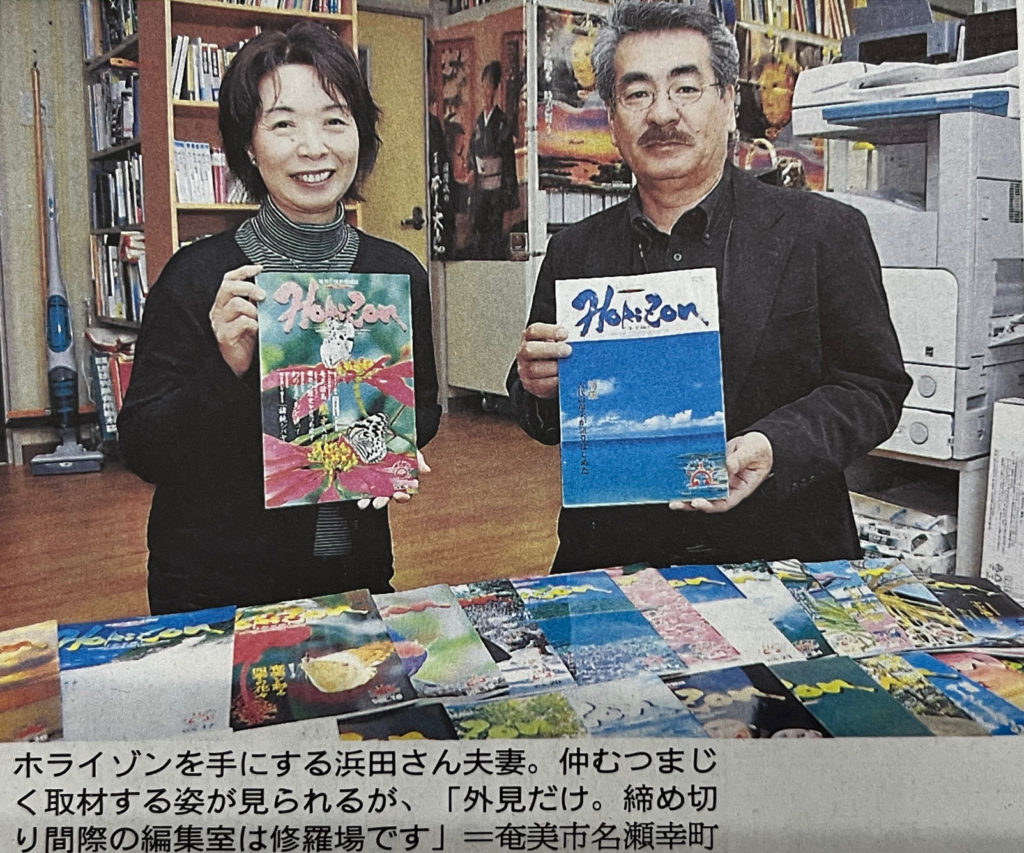
I handled the entire process from planning and editing to proofreading from the beginning. For design, I created rough layouts, but the final design, including the title lettering, was handled by a professional designer living in Kagoshima, whom we worked with for the entire 20 years.
Initially, Hamada and I often clashed over how to place text on his photos. He disliked having text over his images, so each issue involved a bit of a dispute. Of course, we both valued visuals highly, but words were also important, so it was a constant tug-of-war over securing space for text versus space for photos (laughs). Eventually, partly to reduce costs, I started handling almost everything alone: planning, interviewing, and editing. Of course, I relied on Hamada for cover photos and major shots, but I could also supplement with existing photo assets or take photos myself.
After Hamada encountered the Amami rabbit, he became almost possessed, concentrating intensely on that. In my case, I ended up with “Horizon” through circumstance, and once I started, I felt a sense of responsibility to continue. Also, since we were creating it with the help of many people, I felt it would be inexcusable to waste their cooperation. Perhaps my involvement was different from Hamada’s deep immersion. I think, as an outsider, I wanted to be somewhat accepted in Amami. I preferred working steadily alone rather than being in the spotlight, and I wanted to get closer to Amami through my work. As I continued, I was sometimes told, “You know more about the island than islanders do,” which was somewhat embarrassing.
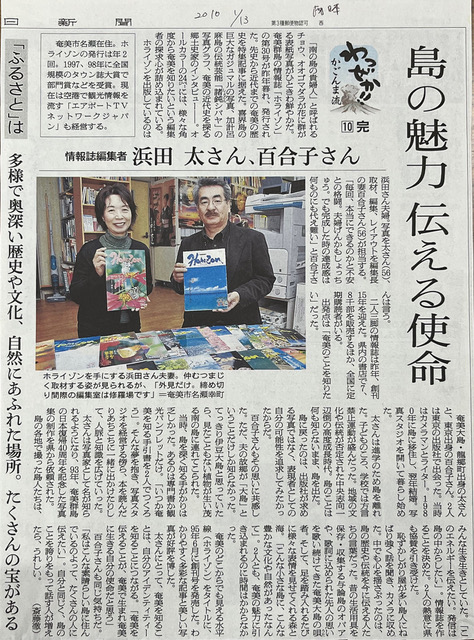
What are some of the aspects of this magazine you are proud of?
At the time, there was a contest called the NTT Town Magazine Festival targeting town magazines nationwide, aimed at supporting those contributing to regional communication and cultural development. I didn’t really think of “Horizon” as a town magazine, but we submitted it from the inaugural issue, partly as a challenge.
Just two years after launch (in 1997), we received notice that we had been selected for an Encouragement Award out of 777 magazines nationwide. I was utterly shocked, like a bolt from the blue. The award ceremony was held at the Imperial Hotel, a lavish setting, with judges including famous personalities like… (Note: The original Japanese names are listed: 渡辺文雄, 赤塚行雄, 阿川佐和子, 木村晴美). According to the judging committee chairman’s remarks, “It’s a very beautiful booklet with substantial content; in fact, we had been paying attention to it since the inaugural issue. However, some magazines end after the first issue, so we confirmed it was continuing before awarding it.” I recall this with deep emotion. I attended the ceremony wearing Oshima Tsumugi. It was covered in the local newspaper, and the local administration and tourism-related organizations held a grand report meeting for the award. The prize money was absorbed by printing costs, but it was a splendid day.
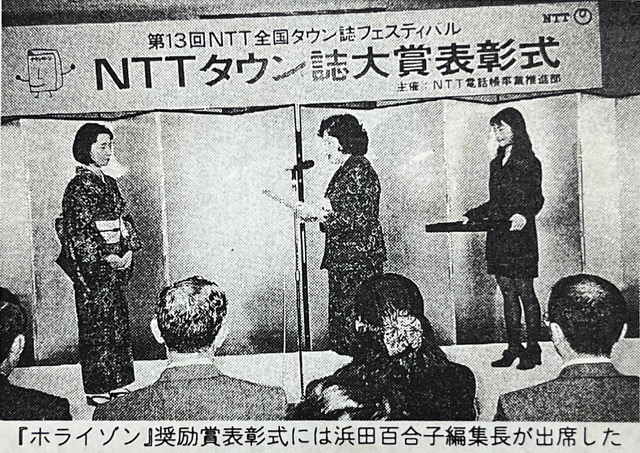
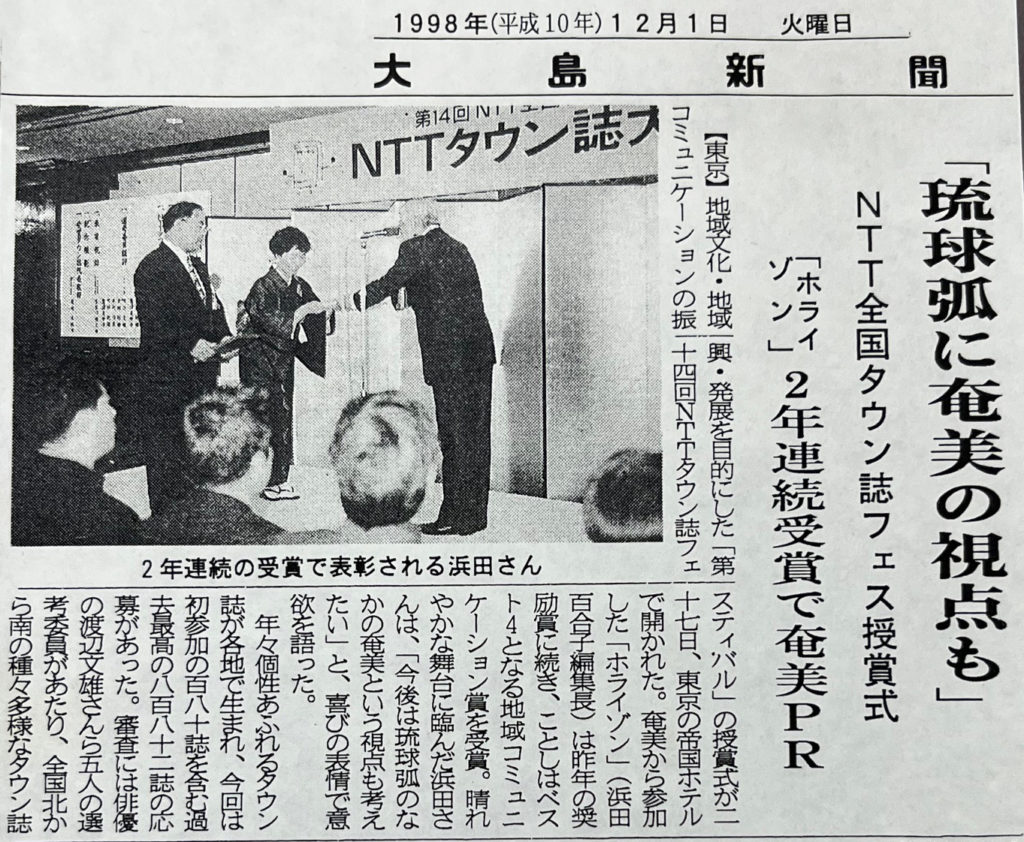
Then, the following year in 1998, we received the Section Award, the “Regional Communication Award,” out of 882 magazines. I think it was an unbelievable honor for a thin booklet published only twice a year from a small southern island to rank among the top four nationwide town magazines. I thought we were on a roll for the top prize next, but unfortunately, the competition itself ended. Still, being recognized nationally became a great source of pride and a significant milestone for us.
How was it distributed?
Apart from supplying copies to the Amami Islands Tourism Federation and sending them to sponsoring administrative bodies and organizations via the Wide-Area Administrative Association (which provided cooperation funds from each municipality), we were allowed to sell it. We sold it at the airport, bookstores, and also through mail order. This decisive move was also thanks to the chief of the Amami Islands Tourism Federation at the time. Each sales outlet cooperated, accepting a wholesale price slightly higher than usual, considering it a community revitalization booklet. Our profit came from copies sold, but since we weren’t sure if it would sell, we only printed 1,000 copies of the first issue. Unexpectedly, it sold out quickly. Reluctantly, we paid out-of-pocket to print an additional 2,000 copies. It was a financially painful expense, but we were happy. We printed a few more of the second issue, which also sold out, leading to a reprint. From the third issue onward, we decided to print considerably more.
Since the Tourism Federation and Wide-Area Association sent copies to related organizations, we focused on distribution at the airport, various bookstores, and also recruited subscribers. We had about 200 subscribers. We included questionnaires and gift corners, so we received postcards with feedback. We also often heard that people would include “Horizon” when sending local specialty products from Amami. Some people proudly said they had all the issues, which was encouraging.
Also, I heard that during a national organization’s meeting held in Amami, a speaker held up “Horizon” on stage and praised Amami for having such a wonderful booklet. This is hearsay, but it made me happy. We have been sending copies from the inaugural issue to libraries in Amami and the National Diet Library.
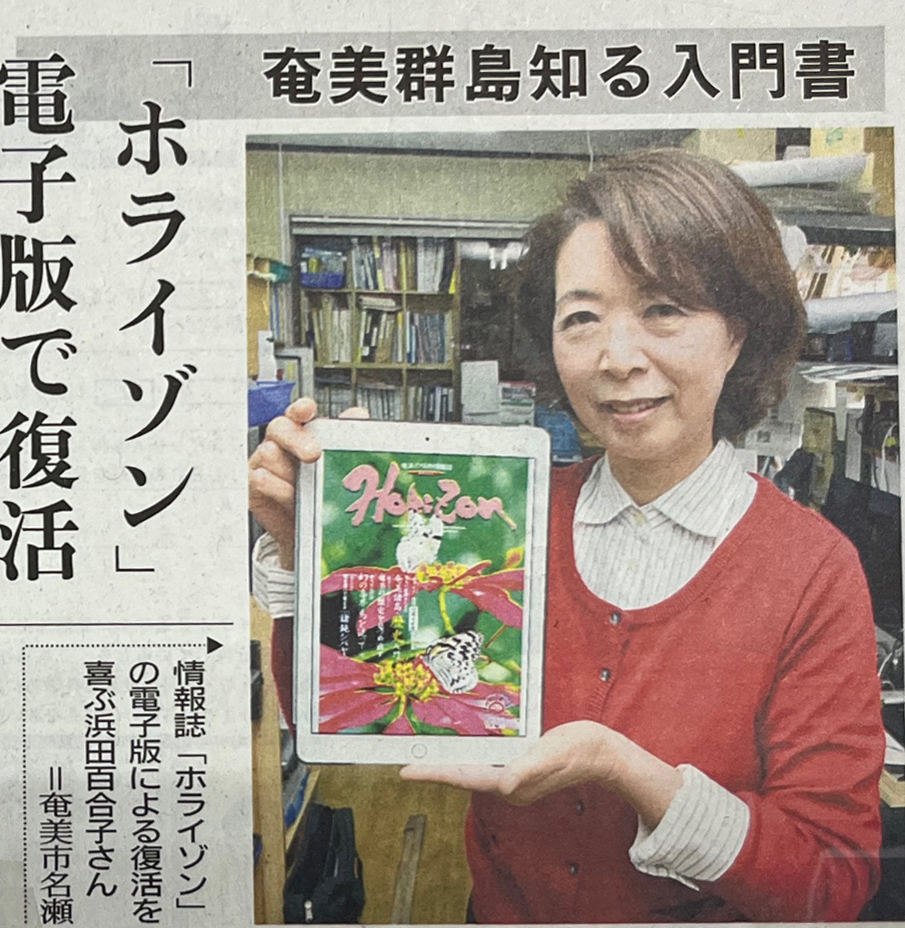
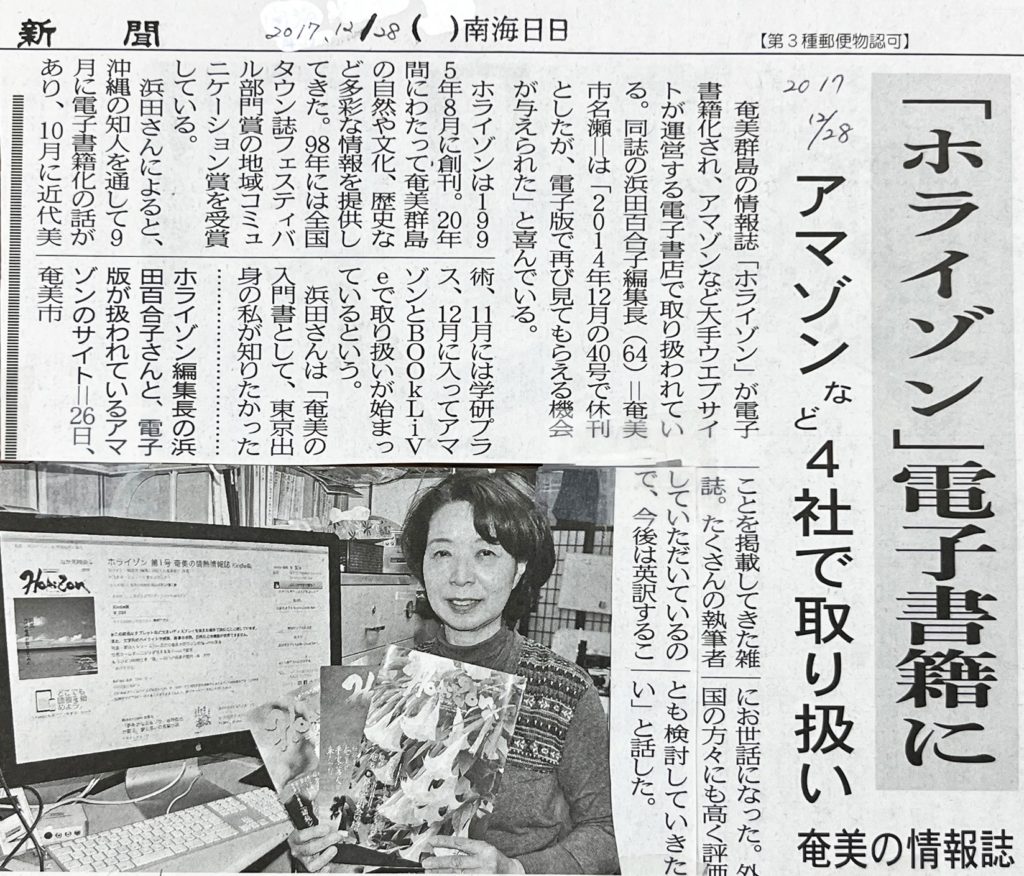
After we ceased publication, we were approached about converting all issues into a digital version. They are now sold as e-books on major platforms like Amazon. The digital version doesn’t sell that well, but since many issues are out of print, having all issues readily available, including advertisements, is something I’m very grateful for.
Were there any feedbacks from readers that made an impression on you?
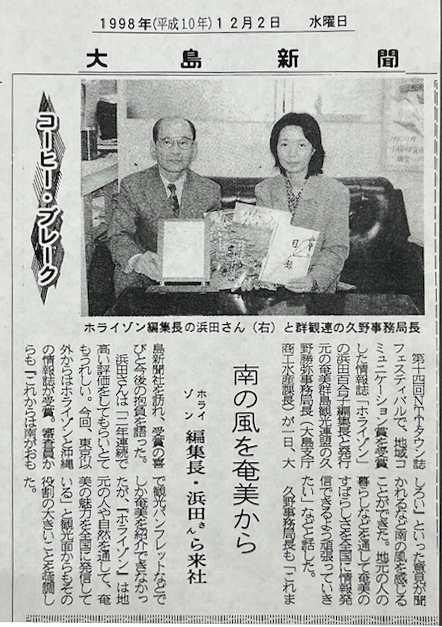
There were many very complimentary words. The words spoken at the Town Magazine Awards ceremony are a treasure; being told “It feels like a southern wind is blowing” made my heart race. Also, some said things like, “We are from the island, but we heard about this for the first time,” or requests for future topics, and sometimes corrections were pointed out. There were proofreading errors, but we usually fixed them with correction stickers.
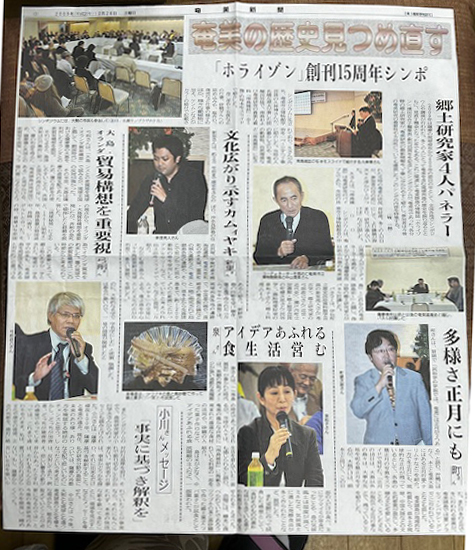
The 15th anniversary year coincided with the 400th anniversary of the Satsuma invasion, so we held a historical symposium at a city hotel. We invited speakers not only from historical research but also from perspectives of food, island songs, and folklore. A particularly significant (harvest) was the words of local historian Masaki Yuge and Hisao Ogawa, a leading authority on shima uta research.
Mr. Ogawa was absent due to other commitments that day, but he sent a message which I, as the MC, read aloud. The content was roughly: “It’s often said that because Amami was oppressed by the Satsuma domain, its songs are mostly lamentful, but I don’t think so. I believe the root of the island’s songs are actually brighter, more lively, energetic songs. I want to say that even in difficult times, the people of Amami lived cheerfully.” Upon hearing this, Mr. Yuge, with a full smile, said, “Even though our fields are different, I’m deeply moved that Mr. Ogawa holds the same view as I do. Even during the so-called ‘Brown Sugar Hell,’ there are historical records showing islanders grew rice, sold banana fiber thread and lumber to Ryukyu to earn a living. The population was increasing, and many plank-built boats (itatsuke-bune) were being made. The islanders lived energetically and resiliently even during harsh times.” This remains strongly etched in my memory. Mr. Yuge left behind such historical records and messages in “Horizon,” and I feel we should explore this further.
Even now, after ceasing publication, there are people who say they were fans of “Horizon.” That’s why I don’t want to let go of the title “Editor-in-Chief.” Recently, when I visited the library on Kikaijima, a staff member said, “You’re the editor-in-chief of ‘Horizon,’ aren’t you?” It made me feel I must stay committed.
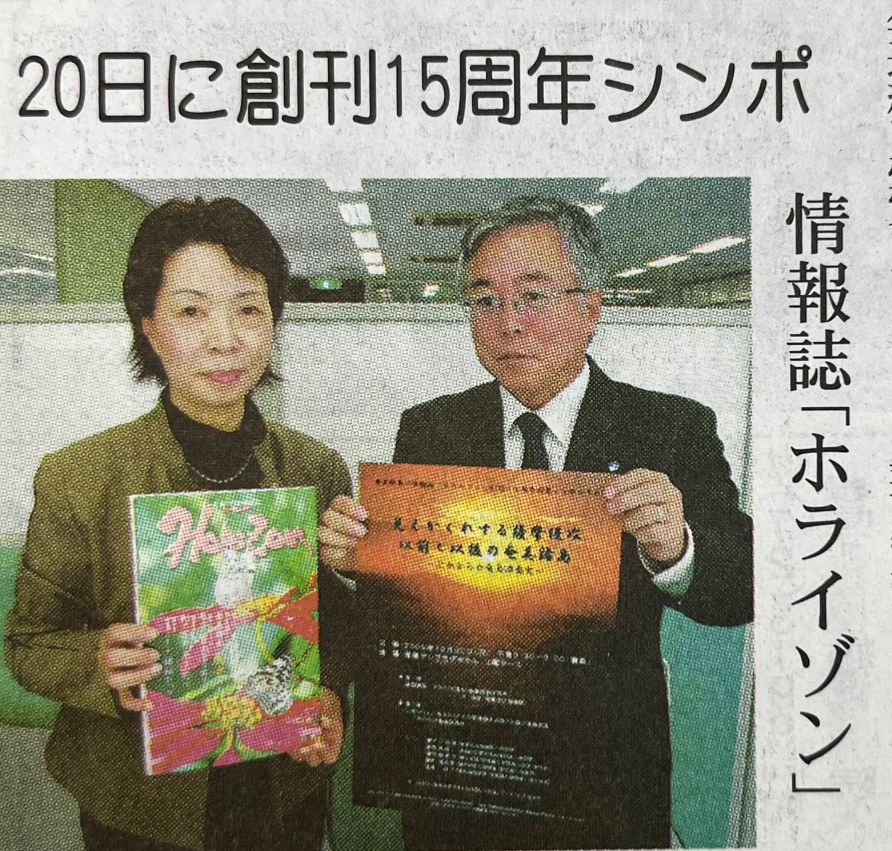
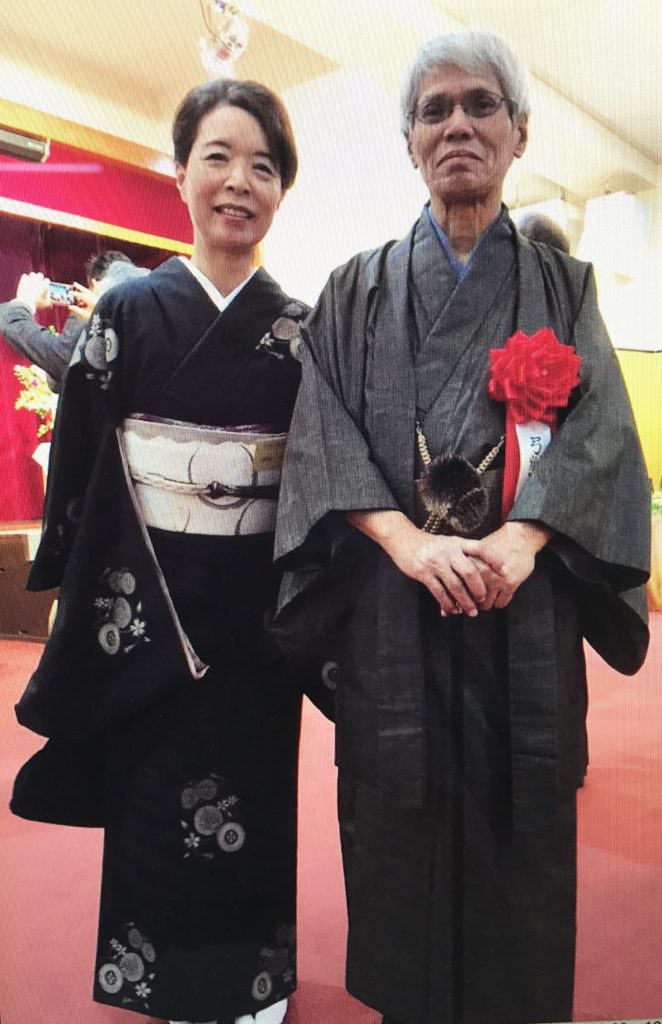
with early modern and later historian Masaki Yuge
How did you choose what topics/aspects of the islands’ life, culture, and environment to cover, not just for one island but for an archipelago of eight inhabited islands? Did you have contributors from the other islands sending stories?
The Amami Islands Tourism Federation requested themes that spanned the entire archipelago, so we selected features that were common to all the islands and also representative of Amami as a whole. Culturally, we covered themes from ancient, medieval, early modern, and modern times, including history like the movement for reversion to Japan. We introduced the islands’ festivals, local performing arts, island songs, new folk songs, instruments like the sanshin and drums, theater, dialects, and local cuisine—including vegetables, fruits, seasonings, pork, fish, chicken, and seaweed, as well as creative dishes that utilized local ingredients.
Kemnun (forest spirits) were a favorite theme of mine. My fondness for them grew so much that we organized the “Kemnun Festa” four times, inviting participation from across the Amami Islands, reaching out to everyone from kindergarten children to the elderly. We held Kemnun symposiums, painting contests, featured Kemnun island songs, and even had a Kemnun bus. A significant achievement was the cultural exchange with Okinawa, which has its own妖怪 (yokai), the Kijimunaa. We were also able to compare legends, folktales, sumo, Noro gods, Yuta spirits, and specialties like Oshima Tsumugi silk and its patterns, bashofu cloth, turban shells, crafts, and raised storehouses (takakura).
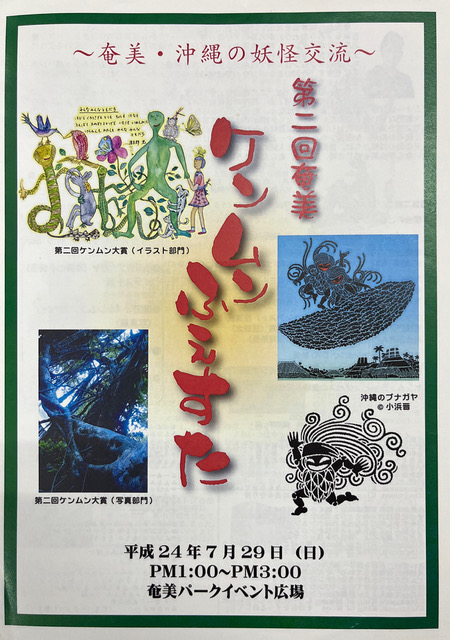
Kemmun Festa 2012

Kemmun Festa 2013
In terms of nature, the islands are divided into high islands with forests and low islands made of coral reefs, each with quite different ecosystems. A clear example is the habu snake; the islands are divided into those that have habu and those that don’t. It’s fascinating how each of the eight inhabited islands is different. Researching them across the archipelago shows that culturally, they roughly divide into Yamato and Ryukyu cultural spheres. However, they subtly overlap and have unique elements, which is very interesting. The real thrill was making these nuances visible within a limited number of pages. Even though we refer to them simply as “Amami,” each island has its differences. Introducing those differences was very engaging. It’s through comparison that the unique characteristics of each island emerge.
While we conducted interviews on each island, we also often had specialists from each place contribute articles. I believe that by writing for or being featured in “Horizon,” the people of Amami were the ones transmitting their culture. I aimed to stay strictly behind the scenes as a support figure. I was the one who primarily researched and wrote the feature articles, but I listed them as “Editorial Department Interviews” and did not include my byline. I didn’t want the magazine to be perceived as a personal or coterie publication.
What were some of the challenges in publishing such a magazine?
The main challenge was funding. I once spoke with a magazine editor from Okinawa who said, “No matter how good your ideas are, you can’t publish if you can’t get advertisements.” Fortunately, we received public sponsorship and some advertising revenue, and we could also sell the magazine. This allowed us to pay our contributors a modest fee, albeit small, and cover printing and design costs. However, driven by the mission of community revitalization, we published the magazine without factoring in our own labor costs.
How long did the magazine run, and why did it stop?
We stopped publication after exactly 20 years. The reason was that many free papers had emerged, and numerous websites had also appeared. Our initial goal of “transmitting information from Amami” was now being carried out by younger people in different forms, so I felt its role for a certain era had concluded. I used the word “hiatus,” but in reality, it was the final issue.
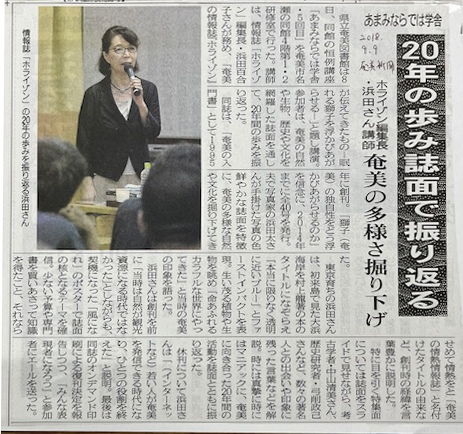
The magazine is now shared on an online platform in both English and Japanese. Why is it important to also share the stories in English?
We created a “Horizon” website in both Japanese and English, an idea proposed by Professor Evangelia Papoutsaki, a media studies scholar. The scope of “Horizon’s” coverage is vast, so we cannot put everything on the website, but we have carefully selected content we especially want international visitors to see. (Horizon Website)
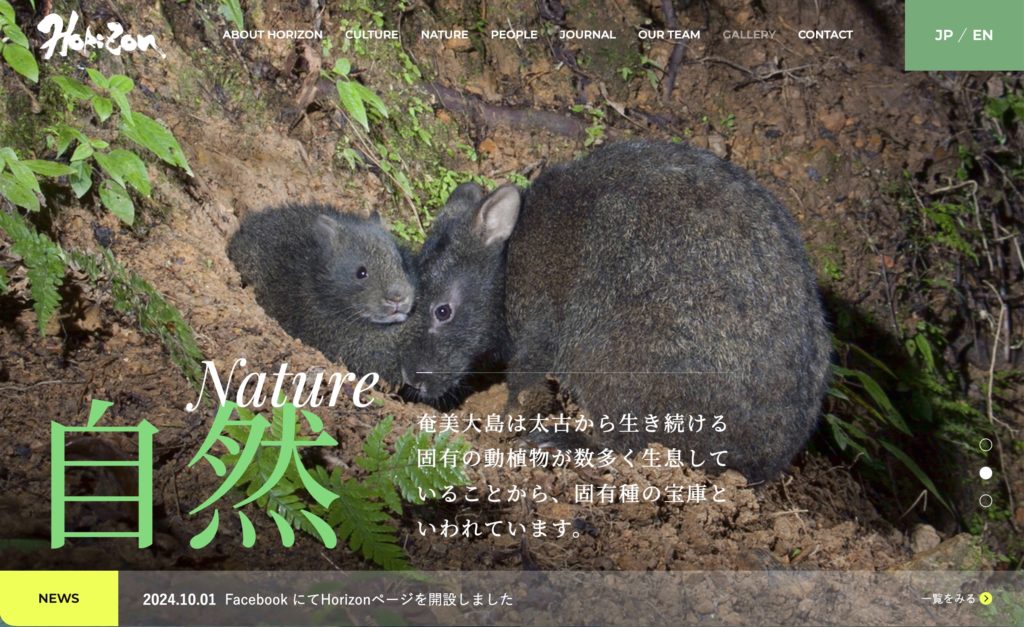
Horizon Website
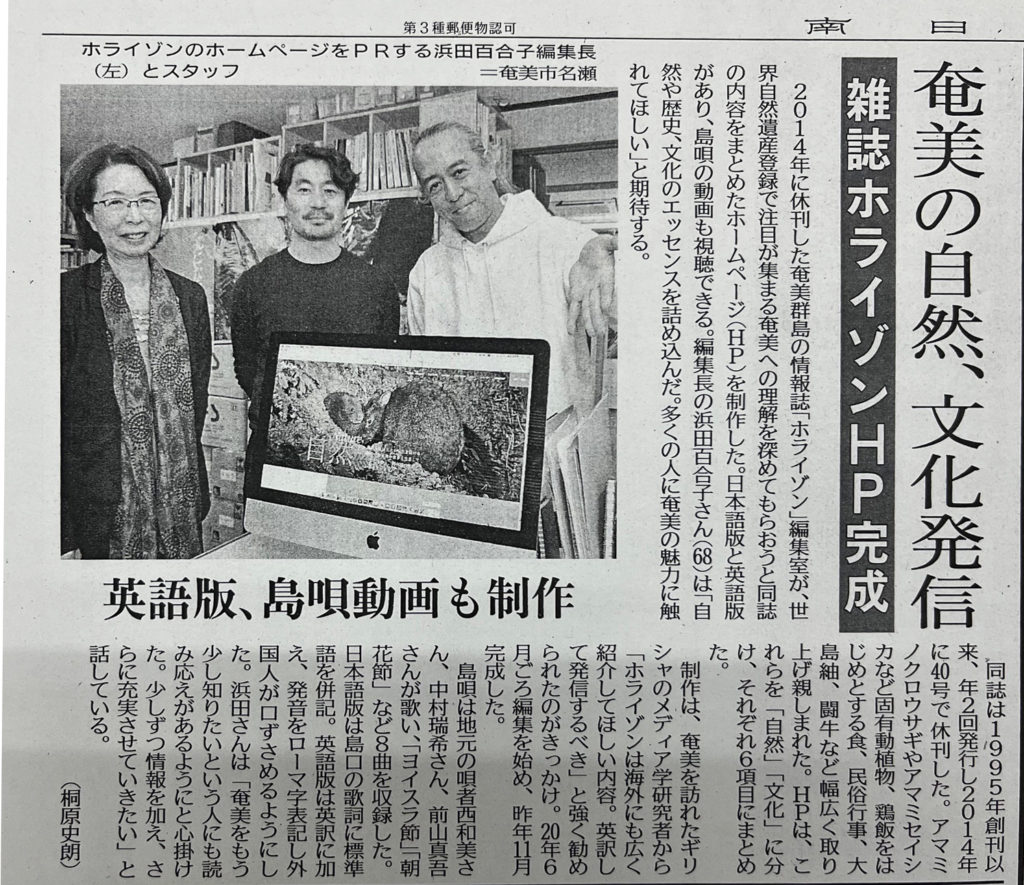

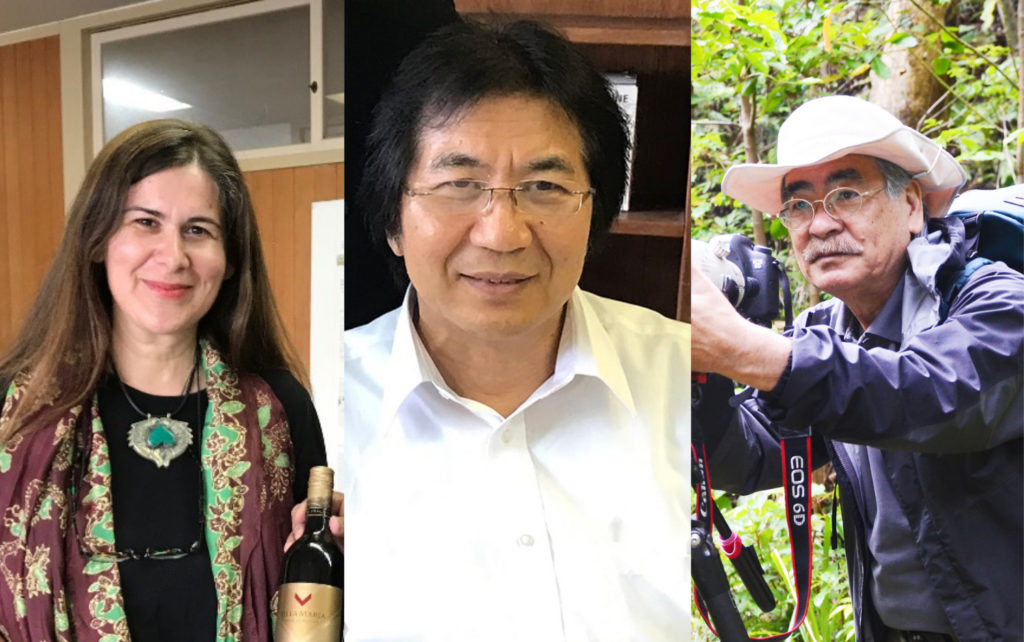
with Professor Papoutsaki
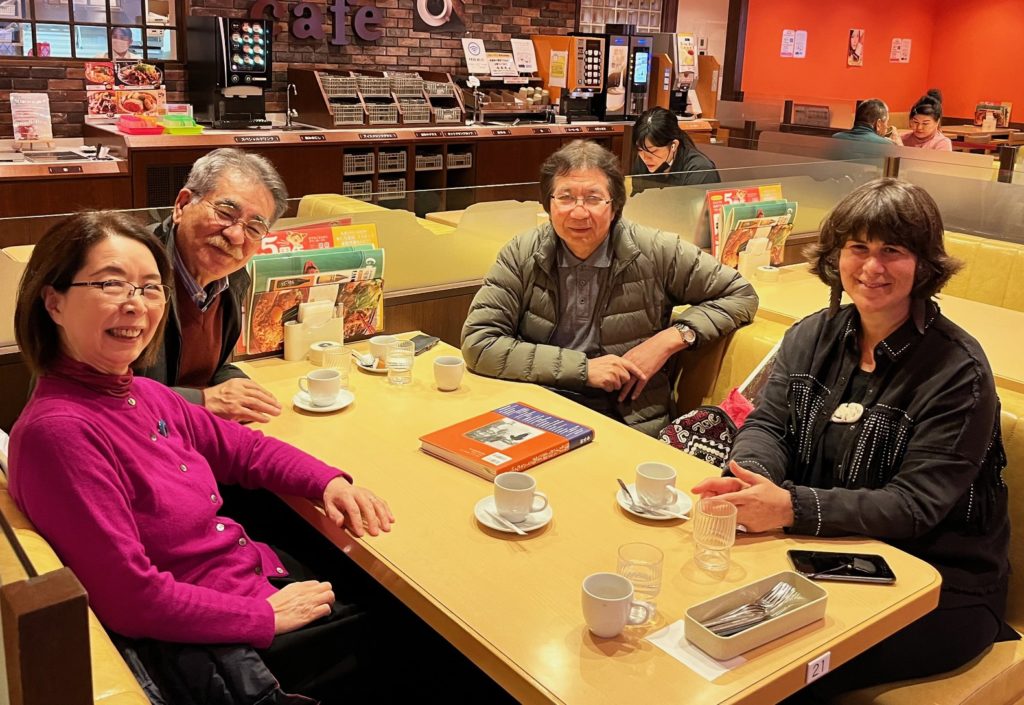
with Professor Papoutsaki and Sueo Kuwahara
Amami Oshima, Tokunoshima, the northern part of Okinawa, and Iriomote Island were registered as a UNESCO World Natural Heritage site in 2021. I believe this has led to more people from around the world turning their attention to Amami. I hoped that this would be an opportunity for more global audiences to learn about Amami, and we prepared for it. Unlike the print version, we could incorporate video, so it was wonderful to be able to showcase Amami’s beautiful, dynamic nature through immersive footage shot with drones. Thanks to these efforts, this website won the Grand Prize at the “Kagoshima ICTel Award 2021.” The selection criteria included the beauty of the images, the rich and diverse content, the accurate and readable text, and the bilingual Japanese-English presentation.
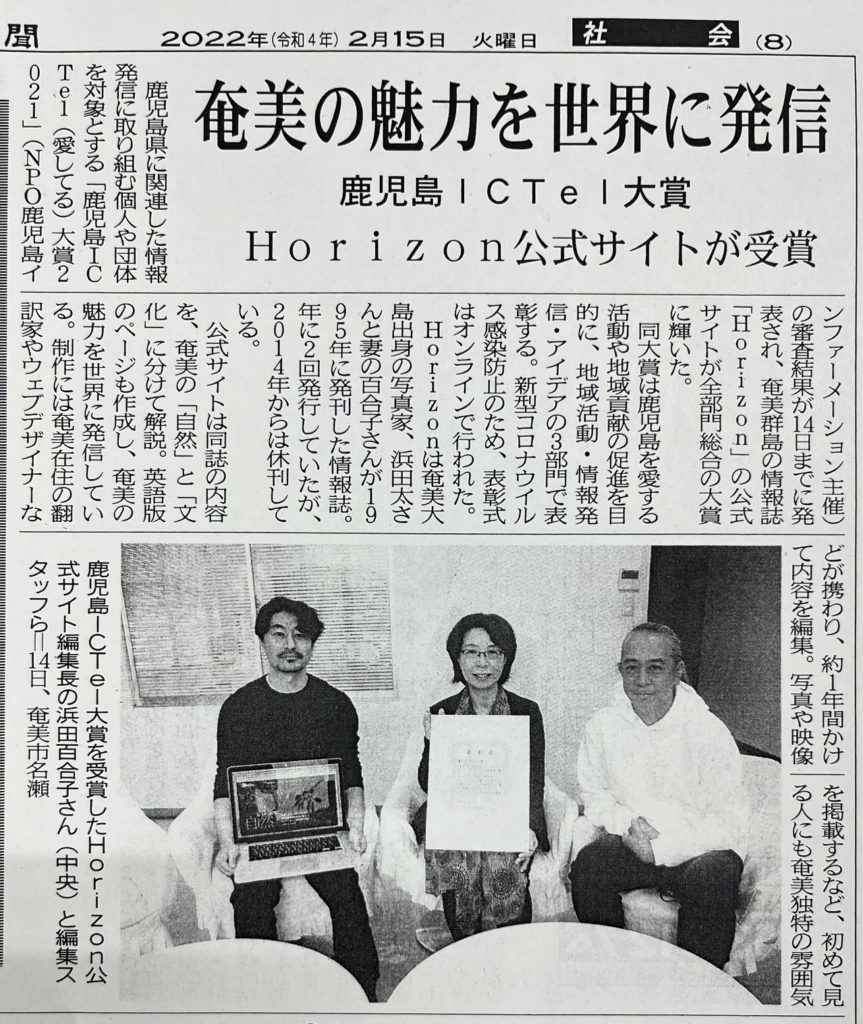
The appeal of Amami is not just its nature; it also has a wealth of culture to be proud of, and the two are deeply interconnected. I want people worldwide to see this. That is why we made it accessible in English—so that people from all over the world, not just Japan, can experience it. We are currently in the process of gradually adding more content.
I am particularly proud of the island song performances. We also share these on YouTube, and they seem to be viewed quite a bit by overseas audiences. The English translations are done by Professor Naoshi Kōriyama, a Toyo University professor emeritus from Kikaijima and an enthusiast of island songs. The performers are singers who have received the Amami Min’yō Taishō (Amami Folk Song Grand Prize), the highest honor in the world of Amami island songs; we asked three particularly popular and skilled singers to participate. Horizon Website Island Songs
Amami singers: Mizuki Nakamura (left), Kazumi Nishi (center), Shingo Maeyama (right)
Are there any similar magazines now produced on the islands by locals?
I don’t believe there is currently a magazine quite on the same scale as “Horizon.” I think “Horizon” was quite comprehensive in transmitting information about Amami’s culture, nature, history, and daily life. We were able to publish valuable documents and photos, and even though it was only twice a year, it represented a significant commitment. Without sponsors, it would be very difficult to create something similar. That said, I would love to see new publications. I’m interested to see how the younger generation will interpret and present Amami.
What do you think is the significance of such a magazine now, with the islands being recognized as UNESCO Natural Heritage Sites?
I want people to understand, through both “Horizon” and the online platform, that Amami is not just about nature, but also about the deep connection between nature and culture. Human life is, of course, part of this; nature, daily life, and culture are all intertwined. Isn’t this true for any country? “Horizon’s” themes were always nature, culture, and the people living there. I hope it helps people recognize that these elements are not separate but are profoundly connected.
After Okinawa’s reversion to Japan, a combination of industry, government, and academia led to many people researching Okinawa. The reality in Amami is that there are almost no universities or research institutions, so I believe there is still a great deal of research to be done. In that sense, the phrase “sleeping lion” might still be fitting. But perhaps now the sleeping lion has barely opened its eyes (laughs).
I wonder what the true, majestic form of this lion will look like. I look forward to the day we can see it on the website.
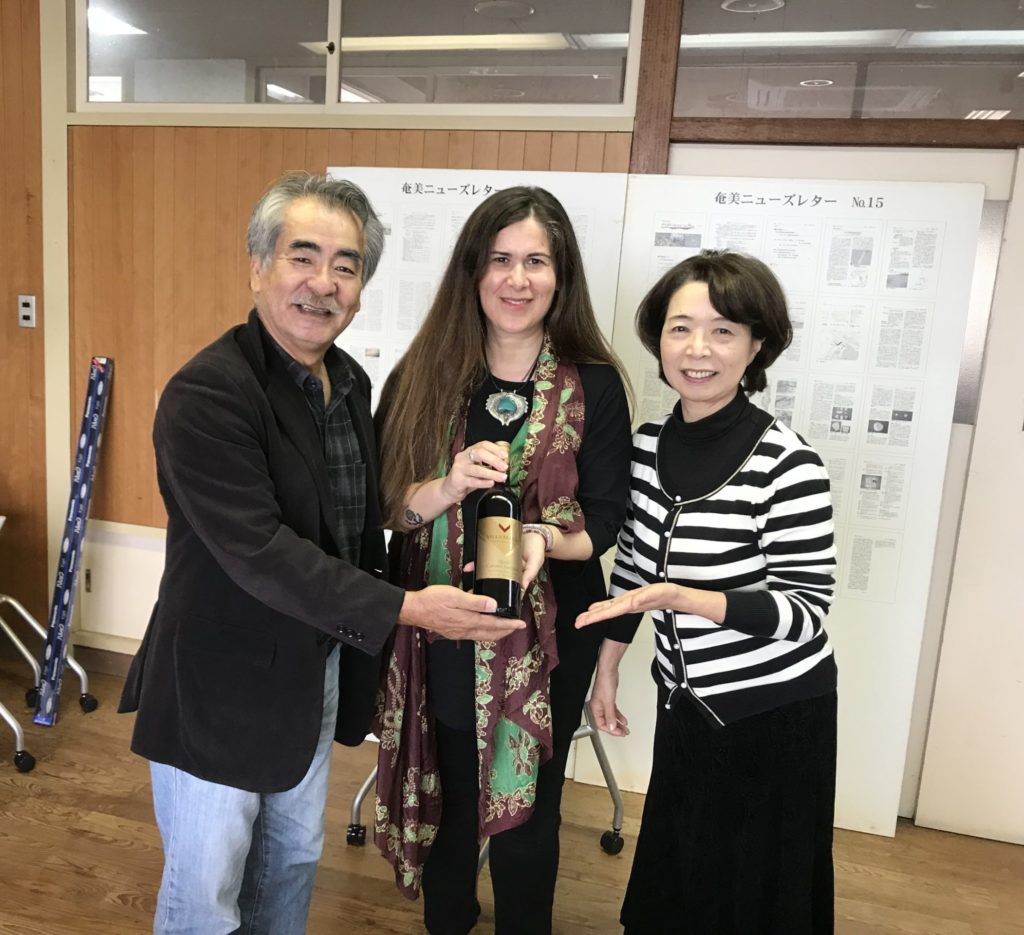


person who wrote this
Dr. Evangelia Papoutsaki
Dr Evangelia Papoutsaki is a New Zealand based researcher, the Convenor of the Small Island Cultures Research Initiative (SICRI), former International Research Fellow at Kagoshima University Research Center for the Pacific Islands, and Editor in Chief of e-Press. She has extensive research experiences in the Pacific Islands and engages in large research projects with island media and communication focus.
During her fellowship in 2017 she conducted her fieldwork in the Amami Islands in collaboration with Professor Sueo Kuwahara. As part of this research, she investigated the islands’ media and used Horizon magazine as one of her case studies. She considered the contents of high quality, and given the lack of information on the Islands in English, she recommended the contents to be translated into English in an easily accessible online platform. In this project, she acts as the English Language Editor overseeing the development of the platform and developing new content in the future.